Our Visit
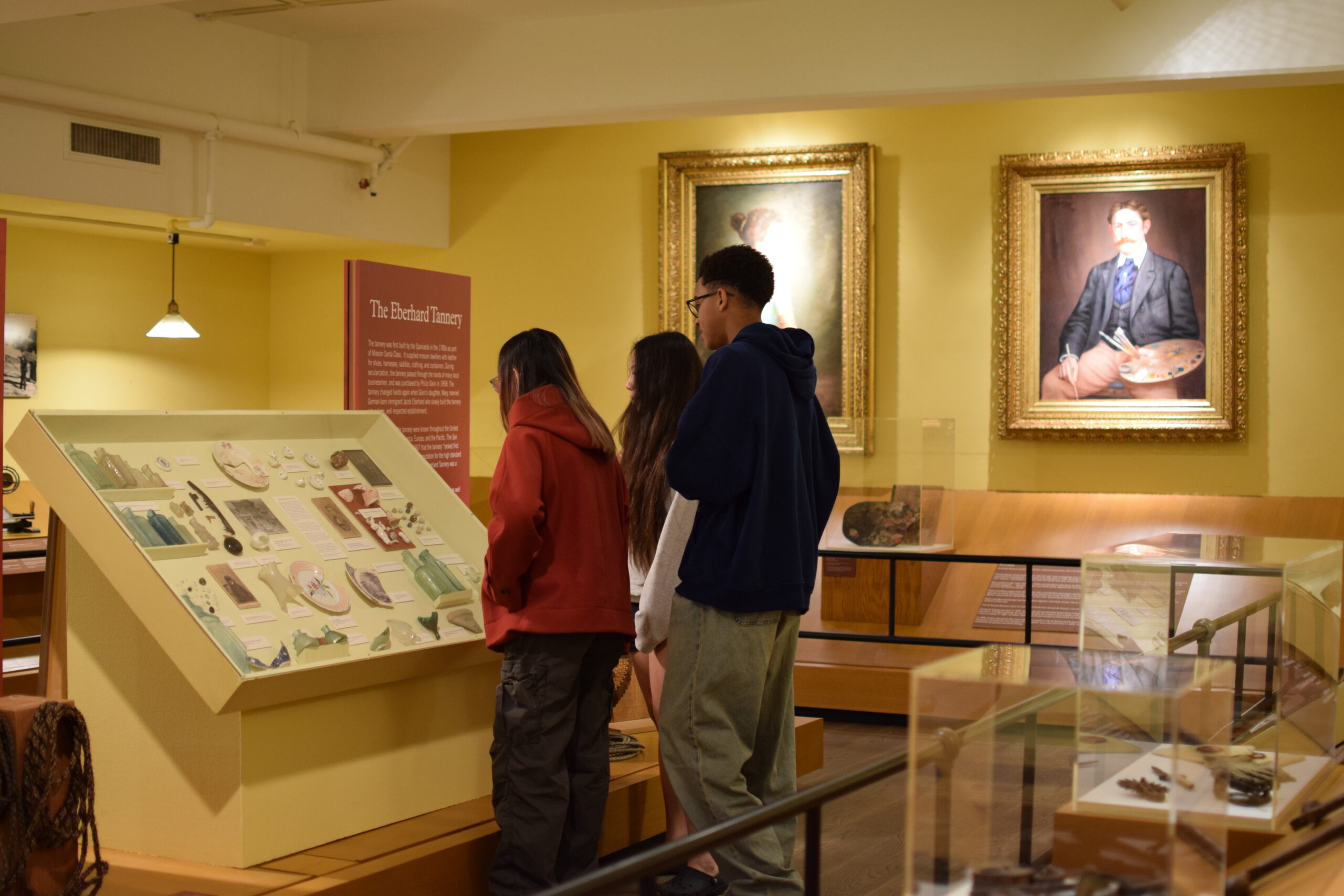
On Jan. 31, UNVEIL visited the de Saisset Museum in the heart of Santa Clara University. We passed gorgeous courtyards of native flowers and trees, finding the museum tucked into a nook off the side of the walkway. Across the sidewalk, standing against a backdrop of palm trees and blue sky, the Santa Clara Mission commands the attention of passersby. With a beacon of Catholic colonialist history located so close to the museum, Santa Clara locals have access to a unique intersection of perspectives: both artifacts from missionaries and native Ohlone peoples decorate the museum floor.
During UNVEIL’s time exploring de Saisset’s exhibits, we were able to reflect on the implications of such contrasting stories sharing the same space. To aid our understanding of this complex topic, Tiffany Au, Derrick Harris, and Kaitlyn Maier spoke with de Saisset Assistant Director Lauren Baines. Baines attended Santa Clara University for her undergraduate degrees in Theater Arts, Art History, and Psychology. After volunteering in the community and working in the museum, Baines discovered her passion for the arts. For the past nine years, she has worked as the Assistant Director of the de Saisset, leading the development of exhibitions and planning events.
Exploring the Exhibits
The de Saisset’s exhibits cover a variety of mediums, themes, and eras. From contemporary knotted abstractions to 18th-century Catholic relics, the museum elevates diverse perspectives. Upon entering, visitors can descend a staircase to simple rooms featuring textured, macrame-style sculptures from Jessica Monette’s “Root Me in the Soil, In the Wake and the Becoming” project. These pieces, made of mixtures of ropes and fabrics, tell the stories of Black culture affected by Hurricane Katrina that devastated New Orleans.
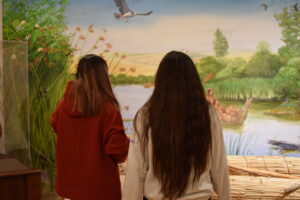
Beyond this exhibit, a different story begins to unfold—one that questions assumptions about colonial history. The story starts with a room full of Ohlone artifacts, with tools and jewelry on display in large glass cases. Through a variety of artifacts like spearheads and beads, visitors can explore the many complexities of a native culture that is often oversimplified in history classes. Rather than simply portraying native Ohlone peoples as hunters and survivors, de Saisset shows their creativity, their construction skills, and their community values. A large mural depicts an Ohlone family sailing on a river in a handmade boat as birds soar above them.
In the next room, the exhibit shifts to focus on Catholic mission culture and the impact of colonialism on native culture. The exhibit displays elaborate metalwork crosses, Baroque oil paintings of religious scenes, and robes worn by religious leaders. These two rooms demonstrate two contrasting lifestyles that existed concurrently and influenced each other. The mission room features explanations of the effects of Catholic missions on native life, highlighting how native labor was exploited for mission construction and how the missions proceeded to overwrite native culture through reeducation and religious control.
In the final room, the focus shifts to California ranchero culture and the secularization of the missions. The Mexican Secularization Act of 1833 transferred ownership of the missions from the Catholic Church to the Mexican government, causing mission land to be reduced and redistributed through grants to cattle and sheep farmers. This room features examples of tools used on the farms as well as other lifestyle items from the era.
At the end of these exhibits, a Kitchen Aid stand mixer sits on a counter next to a mortar and pestle. Baines said this subtle display was specifically requested by the museum’s advisory committee to compare what technologies have been utilized throughout history.
“When we talk about technology and changes over time, it’s not [saying new technology is] better,” Baines said. “It’s just, let’s just see what these changes have been, what we continue to utilize, and what has been adapted.”
Cultural Tensions
Rather than separating mission history from Indigenous experiences, the de Saisset places the two narratives in conversation. The spatial proximity of these narratives forces visitors to confront a complicated question: how can these two histories that intersected so violently occupy the same space today?
To answer that, the museum first confronts the imbalance within the historical records.
“There’s a lot of information that exists from Spanish and European perspectives, and the exhibits prior were very much that,” Baines said. “The balance is like infusing as much as we can with native knowledge and information.”
Spanish records from Mission Santa Clara document the names of only 44% of the Native individuals who lived, labored, and died there — the rest of the names were left out. The archival system itself reflected Spanish language and categorization, at times inventorying native individuals in ways that paralleled how livestock were documented. To counter the bias embedded within these colonial sources, the museum has involved more native voices in recent years.
Balancing the narrative needed more than just adding context; it required active collaboration. Baines described the museum’s role as a steward of conversation, working with Native community members to implement ethical sourcing. Tribe members from the Muwekma Ohlone Tribe and the Ohlone Indian Tribe participated in multiple roundtable discussions during the redesign. Native artists, including Linda Yamane (Rumsen Ohlone), were engaged to help develop mural concepts that reflect regional heritage. The museum drafted materials and invited feedback, creating a collaborative process.
Together, these efforts reflect a commitment to presenting a more accountable history without dictating how it should be interpreted. Rather than offering a simple answer to a complex question, the museum encourages visitors to reach their own conclusions with the facts presented.
“It’s really trying to share these multiple perspectives and stories so that individuals see the bigger picture,” Baines explained. “We don’t give an easy answer. Here are the different realities, and you have to come to your own understanding.”
The museum’s exhibits don’t attempt to resolve the tensions between Native history and the Santa Clara missions. Instead, they bring those tensions to light, inviting visitors to grapple with the historical and contemporary issues natives face.
Upcoming Goals
Looking ahead, Baines identified visibility as one of the museum’s central priorities. Although the museum sits at the center of Santa Clara University’s campus, Baines noted that the de Saisset often feels overlooked, with most students unaware of its presence. The museum aims to become a more active site of dialogue and discovery, where students from every discipline feel encouraged to step inside to engage with the exhibitions.
Baines hopes to continue rethinking how the museum presents information and disrupts traditional exhibition models through collaborations and updates to the space. Through a digital kiosk, multimedia elements, and expanded video interviews, the museum is working to create more easily accessible entry points into complex histories. Baines also shared that they hope to include more contemporary voices of tribal members through photo and video displays to emphasize that the Ohlone aren’t just a story of the past, but rather a community that is still here today.
The museum also plans to host its next symposium with members of the Muwekma Ohlone Tribe, likely around May, continuing its efforts to foreground Indigenous perspectives. Additionally, the 6th Annual Santa Clara University Powwow is scheduled for Saturday, May 2, 2026, where tribes will gather and celebrate their cultures.
Ultimately, these efforts reflect the museum’s commitment not only to preserving history but to continually reshaping how information is presented and carried throughout the community.
Links:
Online Kiosk: https://www.scu.edu/community-heritage-lab/native-cemetery-memorial/
Museum Website: https://www.scu.edu/desaisset/
Ohlone Heritage Hub: https://www.scu.edu/community-heritage-lab/ohlone-heritage-hub/